making another dress
February 22, 2026
As the title suggests, I made another dress!
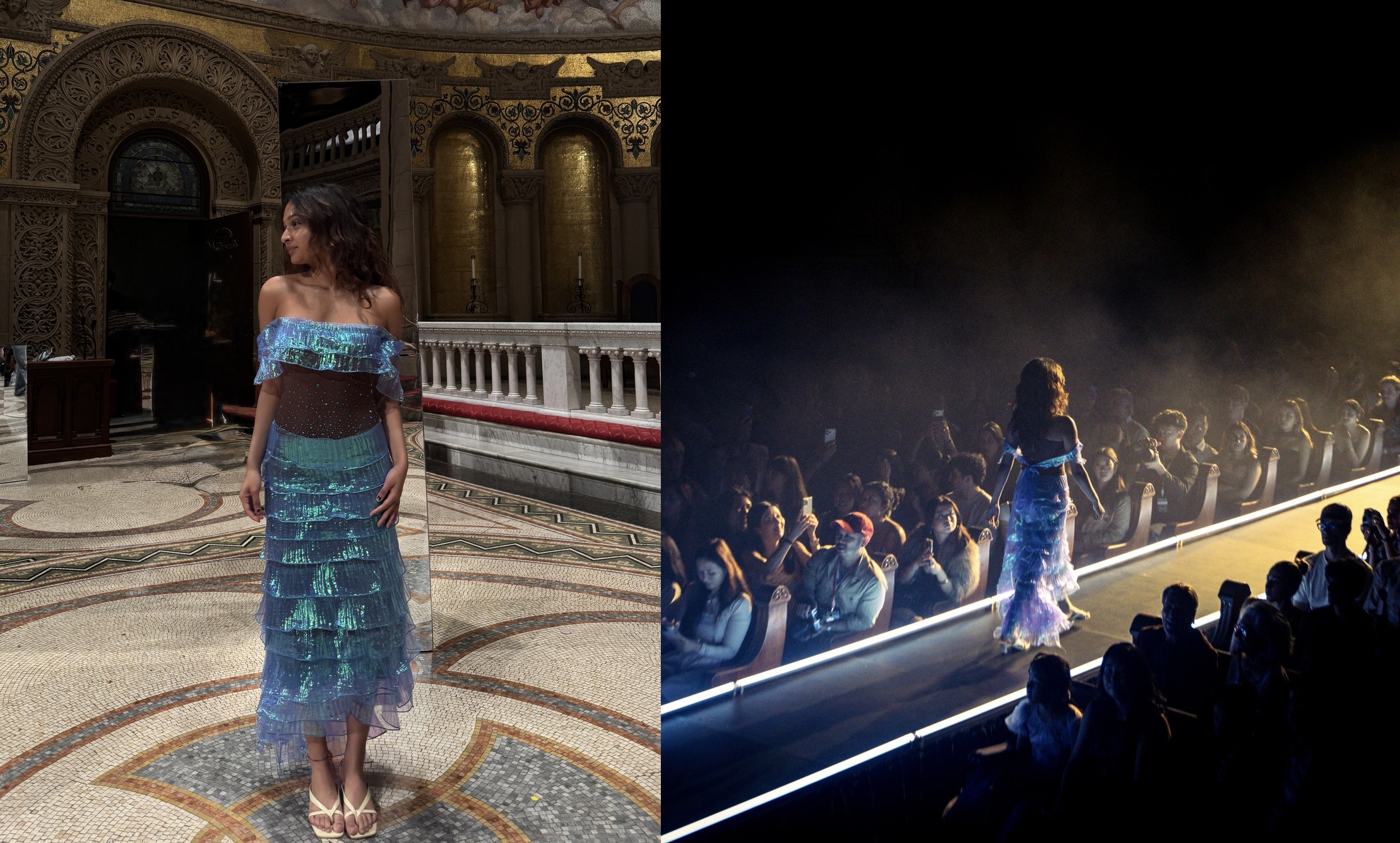
Some background: every year Stanford FashionX puts on a student-produced, student-designed, student-modeled runway show. This year we braved the controversy to again host the show in Memorial Church; see some other designs I loved. Most of the work described took place between February 131 to February 27, 2026.


i. the construction
Many of the show’s designs either had specific concepts (see our opener), or directly reflected (lol) the overall Runway theme (“The Mirror Stage”2). My “creative process” was only loosely guided by concepts, and was instead motivated by the following:
- I had very broad visions of: iridescence, ruffles, Victorian-ness, flowers, long flowy dresses, shimmer, delicateness, water, etc.; see my Pinterest board to understand how incoherent my visual inspiration was
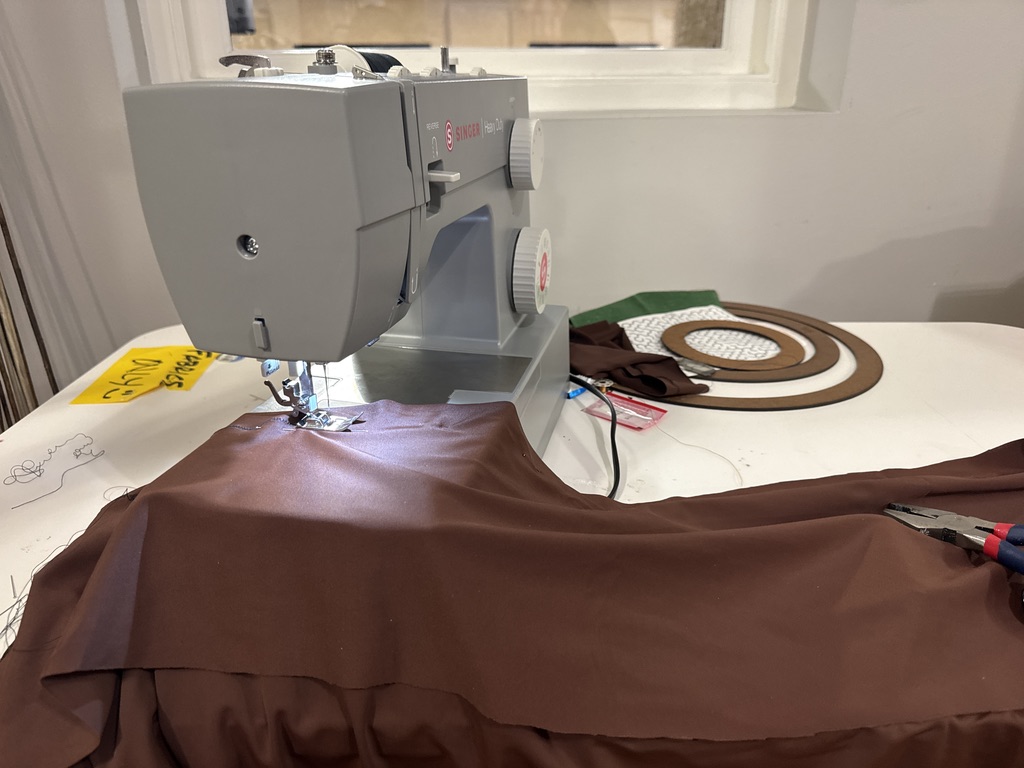
- Last year’s design was actually quite simple in terms of technical sewing; in fact, I used a handheld mini sewing machine for all of the seams and hems. So at the very least, I wanted to use a real sewing machine. It was also a true Runway piece, in the sense that the construction was extremely fragile and could only be worn on display, not for any real occasion. I wanted to work on a dress that involved more technical construction, to force me to actually work on my sewing skill.
- I have been lightly obsessed with organza since Sid’s insane piece which opened last year’s show. Some facts about organza: it is sheer, stiff, thinly woven, extremely prone to fraying, and comes in many beautiful iridescent colors.
- My beautiful model Anushka! I think the colors and textures ended up beautifully complementing her skin tone, hair, and features, and I had her in mind throughout the entire process.
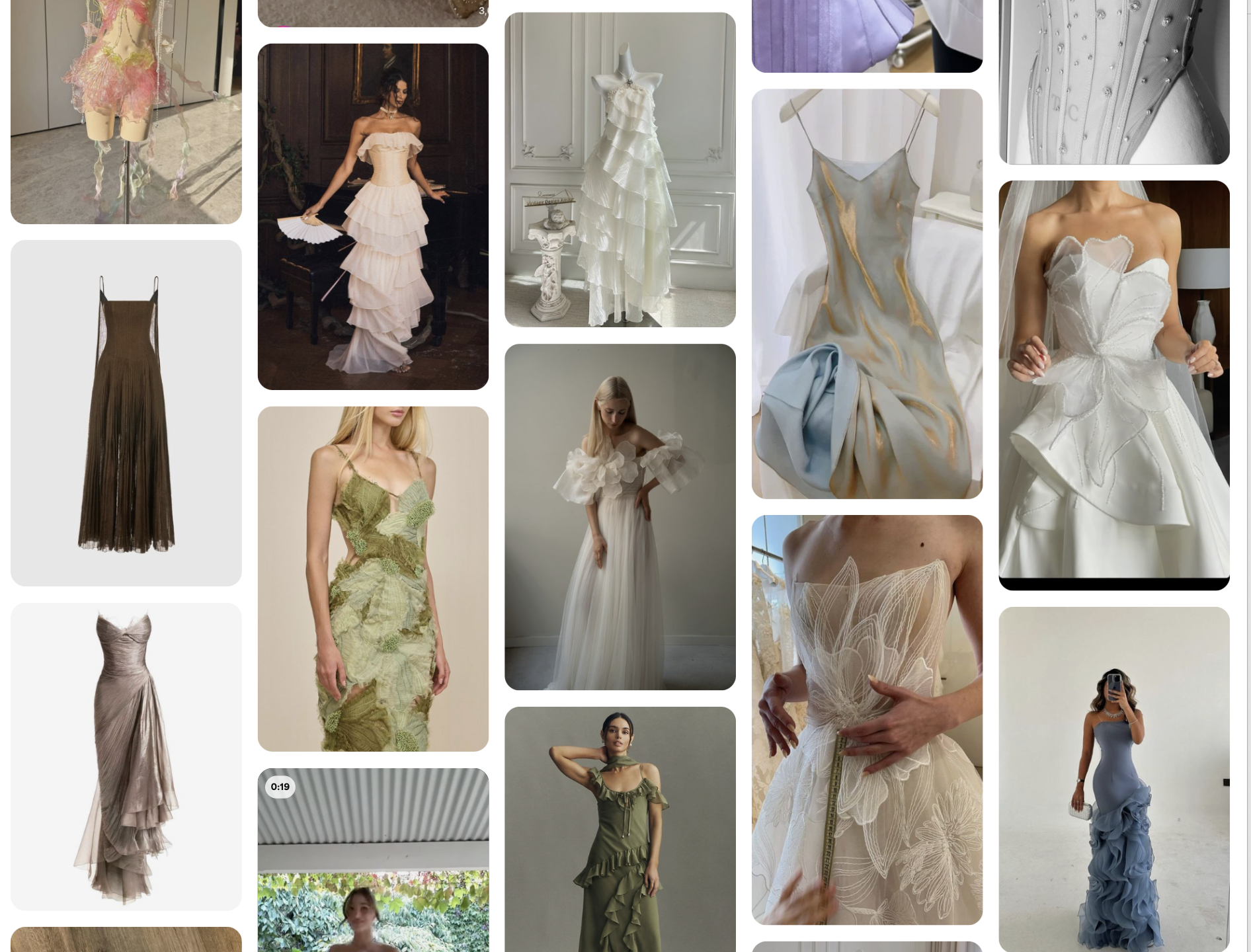
First I was drawn to variants of a thin strap slip gown with thin lines of ruffles all over the skirt, and spent a while playing with the shape of the dress and the placement of the ruffles. My original plan was to make the entire dress out of gold satin basted with the blue organza, so the satin would maintain the lustre the organza while also being opaque enough to be wearable3. Once I bought the satin, I made it through the whole process of [assembling the pattern / cutting the pieces / beginning sewing] before I realized that unfortunately the colors did not mix well at all: at certain angles the basted fabric was a dull purple. Back to the drawing board!
To figure out the design, I ended up buying and testing out ~3 more dress patterns and fabrics. Interestingly, I found sketching basically useless for narrowing down the concept. I eventually settled on a basic understanding of what the skirt should look like: a nude inner slip layer with tiered layers of ruffled organza, packed densely enough that there were no exposed areas of the slip. Thankfully, I also derisked the fabric layering this time.
First I needed to sew the inner slip. This part was very formulaic: print and assemble a pattern (you can alsos drape fabric directly, but at this point I hadn’t bought the mannequin), cut the fabric pieces, stitch up all the seams.
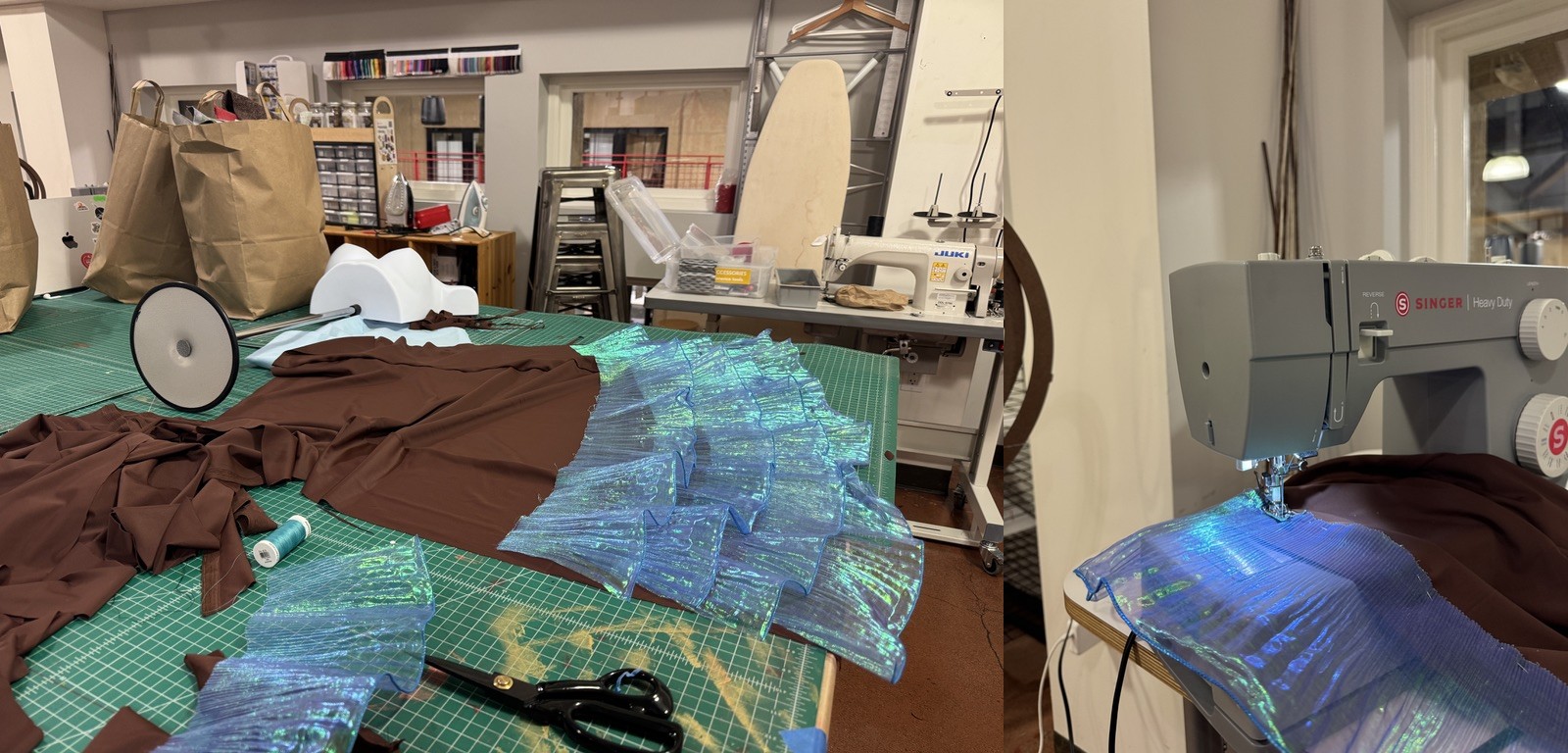
Then came the ruffles! These I sewed on layer by layer starting from the bottom. If you look at the dress up close you’ll notice I started off very, very bad at sewing straight, parallel lines. It’s hard to sew elastic fabrics! Below you can see (left) how I pinned the ruffles on the slip to get a visual idea of the concept and (right) my initial sewing machine strategy, which was (???) to feed the fabric horizontally.
Then I sewed through my finger! No, seriously. One moment the sewing machine was chugging along at a slightly uncomfortably fast clip, and the next there was a sewing needle through the full depth of my finger. More on how this happened in part ii. Shoutout to Alex and his roommate, who just happened to be at the d.school at 10PM on a Saturday and helped clean up the blood on the floor, and shoutout to Mohit for coming to the ER.
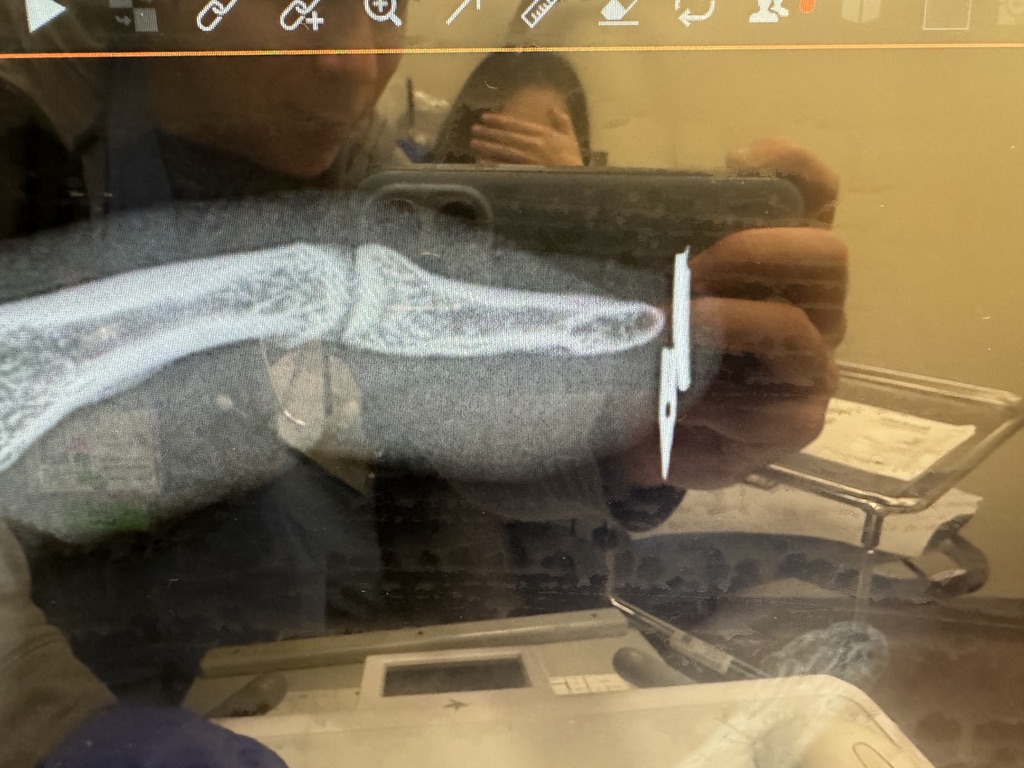
After ibuprofen, bandaids, amoxicillin, and three wine tastings in Napa, I returned to the site of my mishap to finish the project of layering of ruffles. I also had the idea to add a matching ruffle around the top of the bodice, to drape over the shoulders and tie in the back. Then I sewed up the final seam, which involved negotiating with quite the volume of ruffles, and added the invisible zipper. Originally my plan was to complete the piece by resin molding a corset out of the organza, but when I saw just the skirt and top ruffle I felt it was actually better off without the corset.
It turned out that, from my sloppy accounting for the seam allowances, and the accidental scrunching of the base fabric as I added ruffles, the diameter of the skirt was between 3 and 12 inches too short at diferent points. I ended up just free-handing an additional triangle panel for the back, stitching ruffles in the same spacing, and hand sewing the ruffle seams.
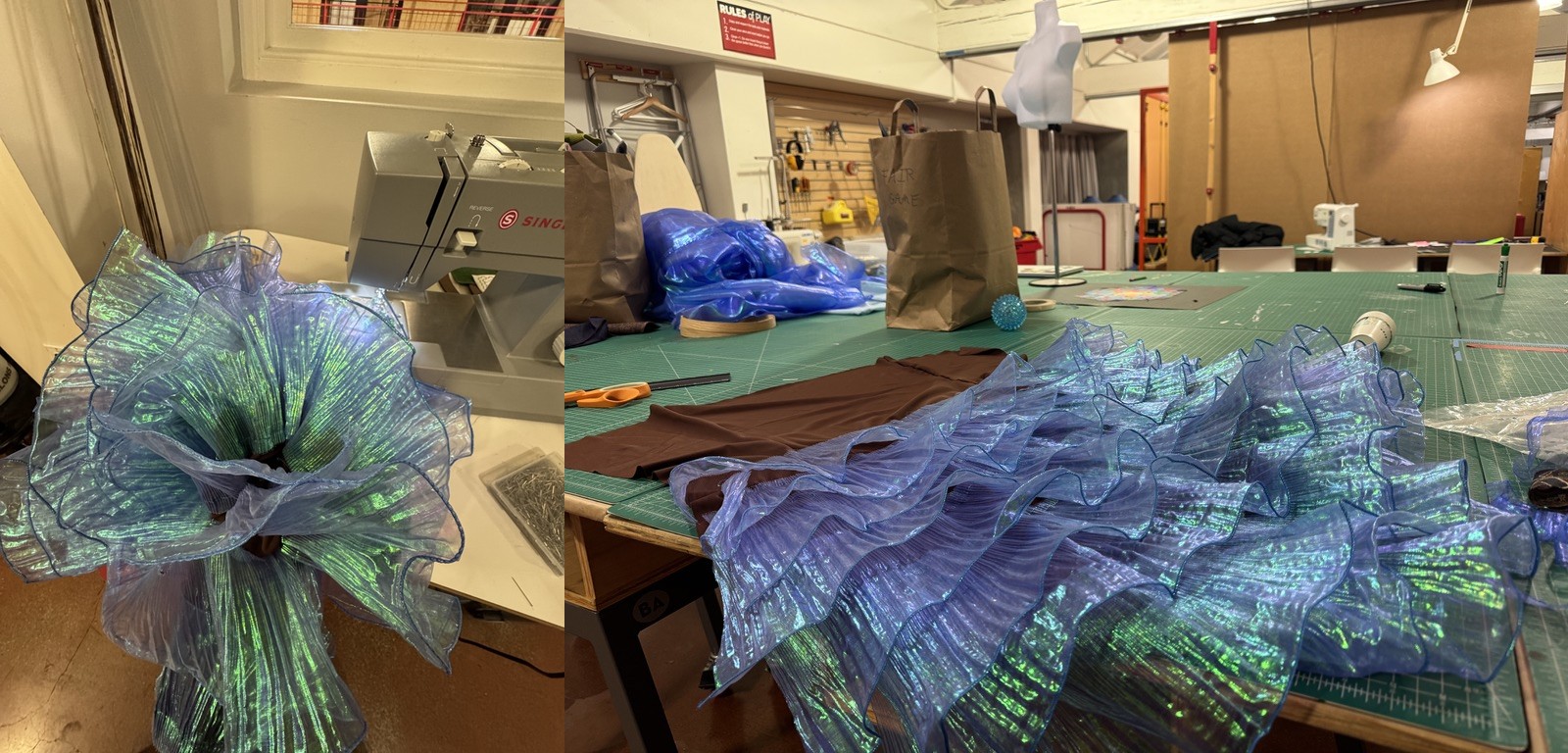
At this point the 80% of the dress was done; the front was almost visually identical between this iteration and the final dress. For the week leading up to the show I kept the dress on a mannequin in the corner of my room. Thus the dress was always top of mind, and I was even more chronically late than usual because sometimes I would get an idea for an adjustment on the way out4.
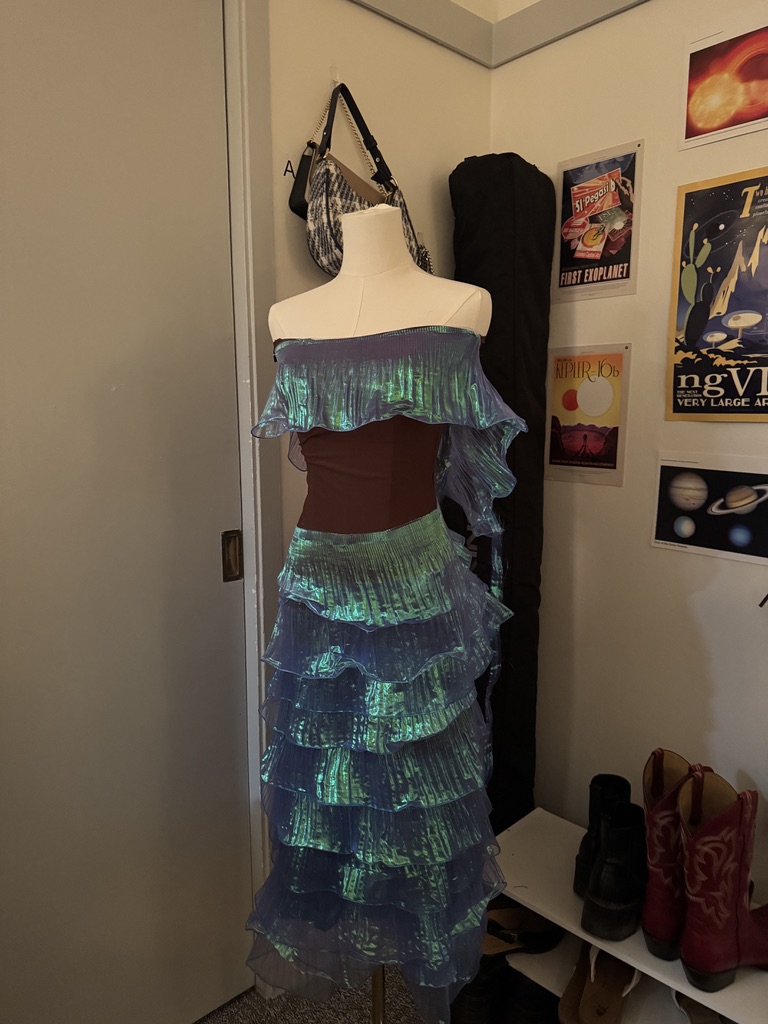
In the week leading up to the show I mostly agonized over small details. I mended some stitching mistakes and covered the bodice in glitter5. When I saw the dress at rehearsal I knew I needed to fix a few issues: the glitter wasn’t visible at all, the bodice was boring and looked unfinished, and the skirt didn’t have enough drama in the back.
I stressed over the visuals for another afternoon and then
- Added a second, thinner layer to the ruffle at the top of the bodice
- Added ~5 more organza layers to the lower back hem, tapering about 2 inches per layer on each side, to form a train
- Replaced the ribbons used to tie the top ruffle around the shoulders with much bigger ribbons which trailed down the back. I had used clear nail-polish to seal the fraying edges of the original ribbons, but this time I sat outside the d.school for 40 minutes running the fabric edges through a candle flame to seal them. Unfortunately some poly fumes were inhaled.
- Glued ~200 rhinestones of various sizes onto the bodice, trying my best to place them randomly
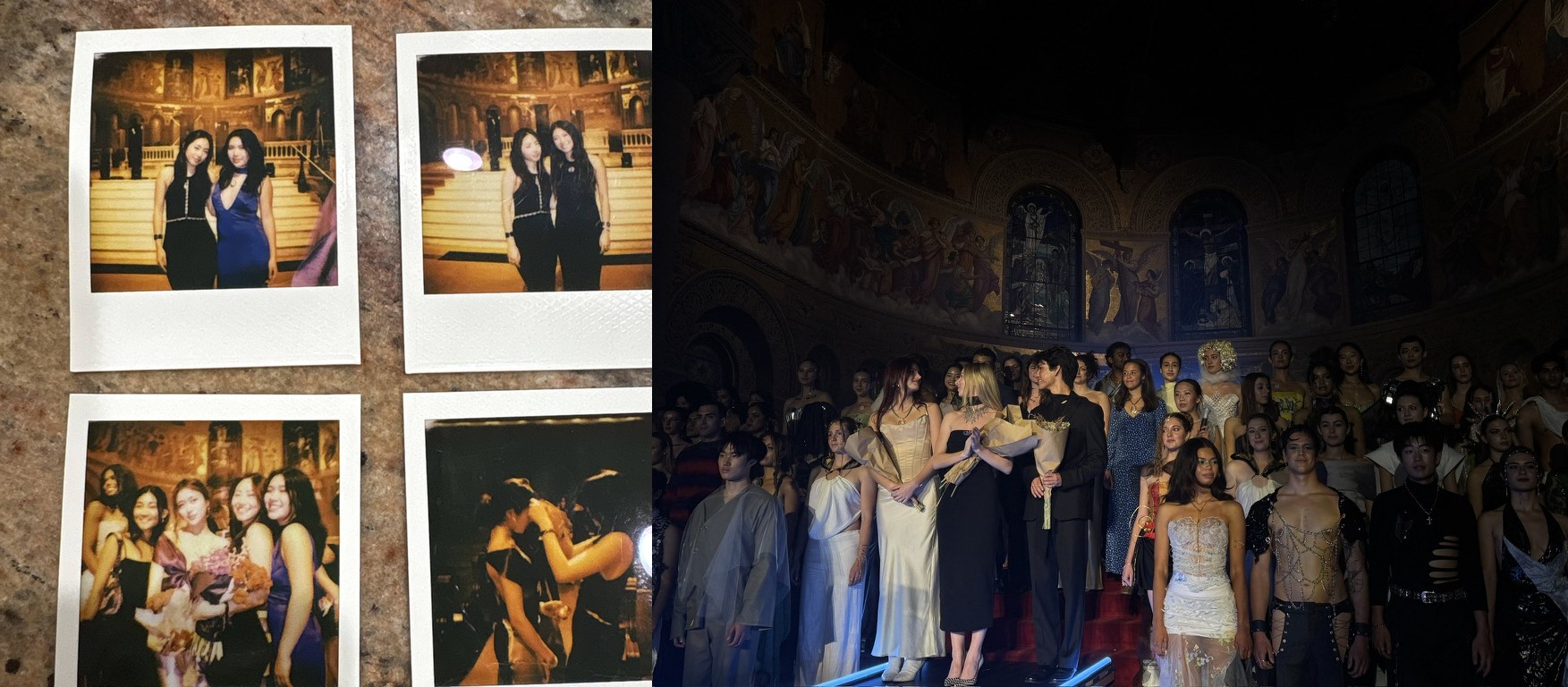
The B7000 wasn’t even fully cured by showtime, but everything went super well! See our show video.
ii. broader reflections
On obsession and my work style: As I learned in 2025, I find it extremely hard to be productive in small time blocks. I have now come to terms with a more aggressive statement of my preferences: that I am most productive and most excited when I have ~unbounded time and an obsession with finishing the thing. The obsession need not exist beforehand, and in fact it rarely does. Rather, it usually appears a few hours in, accompanying a psychological state that could maybe be called a flow state, but feels more like tunnel vision.
It’s a weird state for sure! It leads to strange, almost out-of-character behaviors, like sewing through your hand during hour 10 at the d.school or pulling an all-nighter on a pretraining leaderboard or spending an entire flight to Japan looking at apartment walkthroughs. I feel it in mild forms maybe once or twice per day, including basically every time I go down a research rabbit hole or work on a blog post; once started it simply has to be completed. In more extreme forms, maybe once or twice a month? I’d like to do a better job of tracking this.
For the most part I do like it. I certainly feel very alive, and I have stamina and determination not regularly accessible to me, and it helps me be attuned to the things that I derive the greatest pleasures from working on. My main gripe is not the derailing of my life’s routines – that surely is worth it – but that it almost always leads to me working past the point of exhaustion, and quite often to the point of negative marginal returns. I make stupid mistakes setting up experiments, or get in skiing crashes because my muscles physically can’t generate correct technique anymore, or find myself searching for another problem to solve, another bump of the feeling of forward progress. It is glorious until it is dangerous, but still it would feel somehow insulting to call it quits prematurely.
Still, I feel confident in saying I am much more productive with a target in mind, especially one that requires a bunch of instrumentally interesting learning, and perhaps one that can tolerate a bit of sloppiness6. So the upshot is, maybe I should think less about pursuing practices and more about pursuing projects. I am going to learn how to ski trees, or I am going to run a half marathon7, or I am going to finish this dress.
On runway as a medium: Couture shows can generally be categorized into haute couture (see Iris van Herpen AW25, Schiaparelli SS26) or ready-to-wear (see Dior AW27 at Jardin des Tuileries). Unsurprisingly, I find haute couture much more interesting; it is fashion at its most extravagant, designed only for visual impact without the trite constraints of “wearability” or “conduciveness to mass production”. Pieces are often one-of-a-kind, and as the Met taught us in summer 2024, some of the most iconic haute couture pieces were even designed to walk just once.
Some similar dynamics are at play in our runway show.
- The average viewer sits quite far from the catwalk, so it is quite hard to appreciate fine details from the audience. The pieces need only be sufficiently well-constructed to not literally fall apart on the model.
- Visual impact is only loosely correlated with construction difficulty or sheer time expended. Two of our 2024 show’s most interesting pieces were a sheer dress constructed completely out of tiny hand-assembled chain links, and a structured men’s top constructed of macrame placemats stapled together.
- There are many crowd-pleasing tricks a designer can use, e.g. giant skirts, trains and capes, structured silhouettes, or novel materials.
I thought my piece looked nice on the runway; it’s meant to be seen in motion and in diffuse light! And it’s actually quite sturdy and wearable, so do let me know if you have some occasion to dress vaguely like mermaid royalty. But I concede that the show’s best pieces more fully embraced the maximalism and impracticality. If I designed a third time, I’d want to create something ridiculous in service of visual interest.
On seeing the structure of clothing: Solely from making this dress, I feel that I’ve picked up a lot of intuition for how garments are constructed, and how they can be deconstructed into sewing patterns. Every flounce on a skirt is just a semi-circle! All those gorgeous silk dresses with light, easy movement are just cut on the bias! All the baddie-slop fast fashion8 is full of cheap tricks, from open-back / halter / tie-back closures to ruching / shirring, which are just easy-to-sew patterns that avoid actually having to fit your measurements!
Loosely related: I think I have some mild aphantasia, taking the form of I could conjure up a reasonable apple, but the image disappears instantaneously. The creative process became much easier once I had fabrics in hand, and especially once I had enough done to see the piece take shape on a mannequin.
-
not so coincidentally the day I signed my offer, lol ↩
-
more on the theme: the Runway directors wanted to focus on “introspection, perception, and distortion”. Also provided as references were this Parmigianino (thanks Alex Nemerov) and these Kusama rooms. There are lots of interesting depictions of reflected images in early-ish Western painting, and also a lot of interesting conceptual angles on these ideas, but the dominant interpretation in the show was silver clothing. My broader opinion here is that most fashion that tries to do complex overt messaging falls kind of short. ↩
-
Claude also thought this was a good idea, which I should have known was a bad sign ↩
-
as a child I was scared of ghosts and plastic bodies and would have to hide my dolls in the closet at night, but fortunately I had no such issues with the mannequin. ↩
-
basic physics lesson, the glittery effects of powdered eyeshadow seen up-close are in fact not visible from a distance, mostly because each particle is very small and scatters light in a different direction. This is why “shiny” clothing usually uses sequins or crystals, which reflect a large enough amount of coherent light to actually be visible. ↩
-
Catherine loves to tell me to “measure twice, cut once”, although since I didn’t get into Evergreen Middle School’s woodworking class I never had that lesson properly instilled in me. A moment I’m a bit ashamed of: around 2AM on a Wednesday, I very much wanted to have a mannequin-wearable dress by the end of a work session, and all that stood between me and this state was an invisible zipper. And I had just watched a YouTube video on sewing invisible zippers that day! I managed to sew the orientation of the invisible seams incorrectly three separate times, including by making the same mistake twice, and each time I had to cut ~200 stitches one by one with mini scissors because I didn’t own seam rippers. ↩
-
relatedly, I have basically never felt the virtuous cycle of benefits from building a habit. The most obvious thing one might want to make an exception to project-centrism for is wellness, but I find it remarkably easy to slip in and out of exercise/eating routines. There have been months of my life where I go to reformer pilates 4 times per week and months of my life where I don’t even hit my steps. All it really takes for me to break a habit is for a project of some kind to disrupt my life. ↩
-
unfortunately, I once did an influencer campaign for Edikted. Thanks to Nymphet Alumni for “baddie-slop” ↩